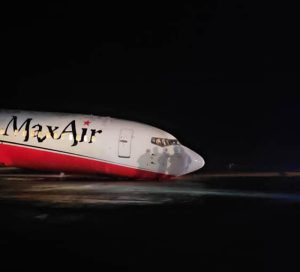
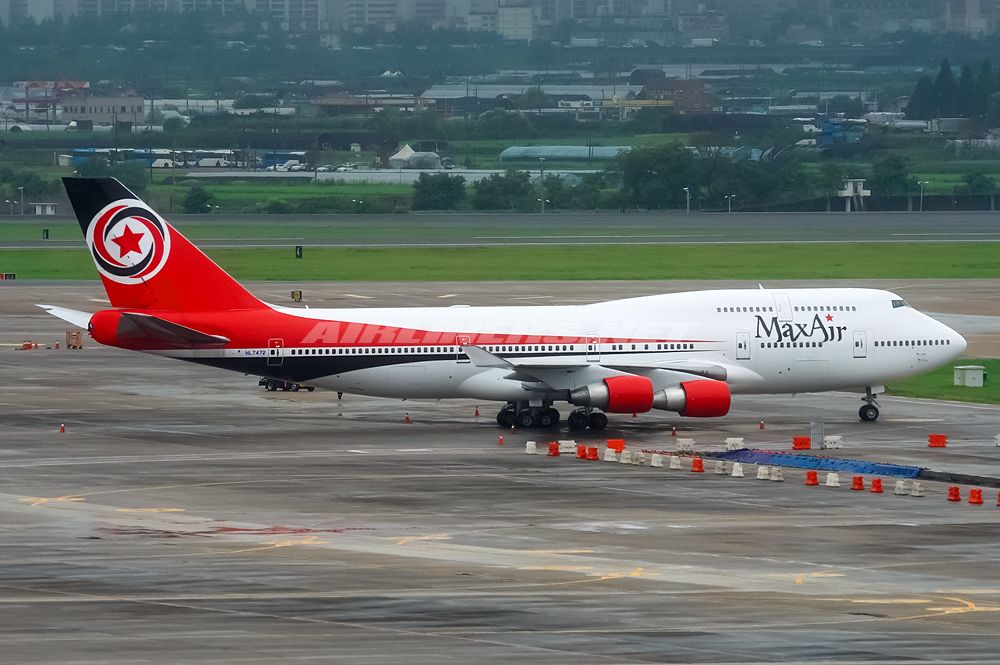
Max Air’s Boeing 747-400
STORY BEACONS
*** The Air Traffic Controller, ATC, and crew members alerted the Pilot in Command, PIC, of a fallen object from the belly of the aircraft
*** The crew did not take adequate measures to confirm the information about the missing wheel assembly
*** Max Air maintenance/quality assurance made a wrong entry of a serial number in its technical log of the incident aircraft
*** Incident aircraft Cockpit Voice Recorder, CVR, was overwritten thus rendering it useless for investigators
*** The Yola ATC Voice Recording System (VRS) did not record any communication between the Pilot and the duty controller on the day of the occurrence.
*** NSIB charges NCAA to conduct regular safety management system (SMS) assessments to evaluate the airmanship of Max Air Limited to effectively manage safety.
Management of Max Air Limited has been charged to pay more than usual attention to its maintenance standards and especially the quality control oversight which has been found deserving of a shot in the arm in order to bring it at par with the recommended standard and practices as enshrined in the reviewed Nigerian Civil Aviation Regulations, NCAR, 2015.
This was part of the findings and recommendations by the National Safety Investigation Bureau, NSIB, as published in its preliminary report on the serious incident involving a Boeing 737-400 aircraft operated by Max Air Limited with Nationality and registration marks 5N-MBD, which occurred between take off at Yola, Airport Adamawa State, and on landing at Nnamdi Azikiwe International Airport, Abuja, Nigeria on 7th May 2023.
The investigation revealed a gross lack of crew resource management by the crew who on taking off at Yola airport, Adamawa, got information from the Flight Purser and a cabin crew reporting that a passenger observed a wheel fell off from the aircraft belly, in addition to similar information from the Air Traffic Controller, ATC, Yola, and Abuja, but the Captain merely responded that “the instruments and landing gear indications were normal”.
According to the interrogation the safety investigators conducted with the Air Traffic Controller, ATC, on duty, after the pilot had concluded the landing procedures, at 14:57 hours, the Abuja ATC prompted the captain of NGL1649 thus, “Be advised, it appears you have smoke around your aircraft. We have called fire watch room”, the Aerodrome Rescue and Fire Fighting Services (ARFF) and emergency services were alerted”.
NSIB reported that the roller bearings on the wheel assembly of No. 1 main wheel, had discoloration and was burnt out. While there was severe fire damage on the No. 2 main wheel assembly.
The interim report revealed that the earlier alarm triggered by a Nigerian Air Force personnel at about 14:08 hrs, from the Air Force Hanger close to runway 35, who reported to Yola Control Tower that an object like a tyre fell off from the departing NGL1649 was later confirmed by a staff of the Federal Airports Authority of Nigeria, FAAN, who, at about 1000 meters from the threshold of Runway 35, Yola airport, found the port wheel assembly of aircraft NGL1648, on 8th May 2023.
Another grievous infraction the airline management was found culpable of, was the repeated overwriting on the Cockpit Voice Recorder, CVR, whilst not a first offender in this regard.
Another act alien to air safety unearthed by the investigators was the grievous infraction by Max Air management whose maintenance crew was discovered to have been fatally flawed, by making a wrong entry of a serial number in its technical log of the incident aircraft.
Max Air was also found to be lax in the supervision of its aircraft maintenance as a brake unit and the wheel change executed two days before the serious incident; 5N-MBD were not adequately supervised by the quality control department.
SAFETY RECOMMENDATIONS
Nigerian Civil Aviation, NCAA, had been strongly urged to start without further delay, conducting of regular safety management system (SMS) assessments to evaluate the capability of Max Air Limited to effectively manage safety.
The NCAA was also compelled to ensure that the Pilot Monitoring, PMI, and Pilot In Command, POI, of Max Air Limited, increase surveillance and oversight to ensure maintenance and flight operations are carried out in accordance with NCAA Technical Guidance Material (TGM) Volume IV (Airworthiness Inspector’s Handbook) Chapter 23 (Continuing Surveillance) and TGM Volume III Flight Operations Inspector’s Handbook Chapter 30 (Continuing Surveillance).
NSIB charged that Max Air Limited as a matter of policy, “should ensure that flight crew displays good situational awareness and airmanship at all times during conduct of flight operations in accordance with Max Air ops manual”.
On the seeming consistency of Max Air to overwrite on its CVR, NSIB prompted NCAA to without further delay, invoke the relevant sections of Nig.CARs 2015 in accordance with IS 1.3.3 Legal Enforcement Actions to non-compliant operators with the AOL (NCAA/FSG/AOL/19/03) on continuous overwriting of Cockpit Voice Recorder (CVR) Information.
Taking cognizance of the communication between Yola and Abuja airports that was not recorded due to a remote infrastructural challenge, NSIB, alerted NCAA to ensure FAAN/NAMA provide uninterrupted power supply in order to avoid the vulnerability of operational equipment.
Further Investigations to be conducted to unravel a few other riddles on the serious incident include the inspection of the roller bearing and other accessories.
NSIB however pledged that it will conduct with dispatch, the retrieval of pertinent documents from Max Air limited, other stakeholders, and Pertinent factors leading to the drafting of the final report.
About Post Author