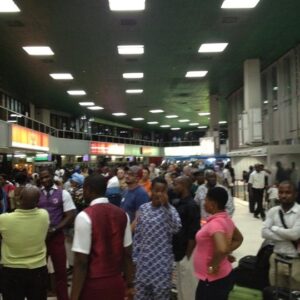

Murtala Muhammed International Airport, MMIA, Ikeja, Lagos, have its passengers’ foyer filled to the brim at one of its peak periods
By Henry Agbebire
In the fast-paced world of digital journalism, a compelling headline can travel farther than the truth it is meant to convey. This reality played out recently in an opinion article titled “Economic Insensitivity: The Arbitrary Spike in Parking Rate at Lagos Airport.
”While the concerns raised about rising costs deserve public attention, the argument presented in the article and, more importantly, its attribution, was fundamentally misleading.
Let us be clear from the outset. The parking rate issue referenced in that article pertains to the Murtala Muhammed Airport Terminal 2 (MMA2), a privately operated terminal concessioned to Bi-Courtney Aviation Services Limited. It is not a facility managed or operated by the Federal Airports Authority of Nigeria (FAAN).
However, by broadly referring to “Lagos Airport” and illustrating the story with images of the Murtala Muhammed International Airport (MMIA), which is under the management of the Federal Airports Authority of Nigeria, FAAN, the article creates a powerful but erroneous association in the public mind. This is not a trivial mistake. In aviation, perception is reality, and misinformation, even when unintended, carries significant consequences.
The Lagos airport ecosystem is unique and often misunderstood. The Murtala Muhammed Airport Terminal Two, MMA2, is operated entirely by Bi-Courtney Aviation Services Limited, BASL, under a concession agreement. All commercial decisions within this terminal, including parking fees, are the responsibility of the concessionaire.
The Murtala Muhammed International Airport, MMIA, (the international terminal and other domestic terminals thereof) is operated by FAAN) Also, FAAN oversees infrastructure, safety, and service delivery across the federal government-owned airports nationwide.

It is important to clarify for the benefit of the flying public, that the mandate of FAAN which is statutory and specifically tied to airports owned by the Federal Government of Nigeria, FGN. Not all airports in the country fall under this purview. Nigeria’s aviation landscape includes concessioned terminals, such as MMA2, operated by a privately owned firm, Bi-Courtney Aviation Services Limited, BASL.
State-owned airports are infrastructure investments, developed and managed by the state government. Some on completion are handed to concessionaires for efficient, effective and profitable operation of the facility.
There are other privately managed helipads and specialised aerodromes, operating under approved framework as sanctioned by the regulatory authority, the Nigerian Civil Aviation Authority, NCAA.
While these airports may differ in ownership and management, they are all regulated by the Nigeria Civil Aviation Authority (NCAA), in harmony with the International Civil Aviation Organisation’s (ICAO) recommended standards and practices.
Consequently, the Federal Ministry of Aviation and Aerospace Development will also ascertain that such an airport, helipad or aerodrome aligns with the government’s air transport developmental policy guidance. This distinction is critical to understanding where operational responsibility and accountability truly lies.
This is why the difference is not merely academic. Understanding is attained by hands-on experience, acquaintance with the principles of business ownership and its legal responsibilities. Hence, ascribing blame to FAAN for a terminal that is managed by a privately owned entity smacks of ignorance of airport ownership and management. It’s a fatal error to blame FAAN for a decision made by the independent management of a terminal.
The aviation sector is one of the most sensitive and perception-driven industries in any economy. A single misleading headline can erode public trust in airport authorities, misguide regulatory expectations by placing pressure on the wrong institutions, undermine investor confidence, especially in a sector where public-private partnerships are critical, and distort policy conversations, leading to ineffective or misplaced interventions.
In this instance, calling on FAAN and the Honourable Minister to intervene in a concessionaire’s pricing decision reflects a misunderstanding of government business structures in Nigeria’s aviation industry.
Pieces of opinion are powerful tools for shaping discourse. But with that power comes responsibility, particularly in sectors like aviation where operational structures are complex and where safety, efficiency, and public confidence are deeply interdependent. Writers and analysts must go beyond casual observation. In most cases, a simple verification, such as identifying who owns and operates a facility, can prevent widespread misinformation.

This is not about silencing criticism. On the contrary, constructive criticism laced with facts is essential for growth and development. But when facts are blurred, even valid concerns lose credibility.
The Federal Airports Authority of Nigeria has consistently demonstrated its commitment to transparency and public engagement. It has, on several occasions, issued clarifications to correct misconceptions about airport operations, infrastructure responsibilities, and service delivery standards.
As Nigeria continues to modernize its aviation sector, clear communication becomes even more critical. FAAN as an airport manager must be understood and be appraised in consonance with its mandate as enunciated in the statute that established it as an agency of the federal government. Hence, accountability must be directed accurately.
Mislabeling MMA2 as “Lagos Airport” in a way that implicates FAAN is not just an editorial oversight; it is a distortion that affects reputations, policy dialogue, and public perception.
In an era where information spreads instantly, accuracy is no longer optional; it is essential. The aviation ecosystem depends on trust: trust in institutions, trust in operators, and trust in information.
For journalists, analysts, and commentators, the charge is simple but profound: verify before amplifying. In aviation, as in journalism, precision is not a luxury; it is a necessity.
Henry Agbebire
Director, Public Affairs and Consumer Protection at FAAN, writes from Lagos.
About Post Author