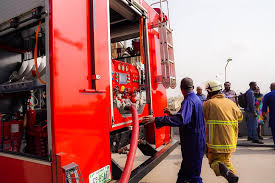
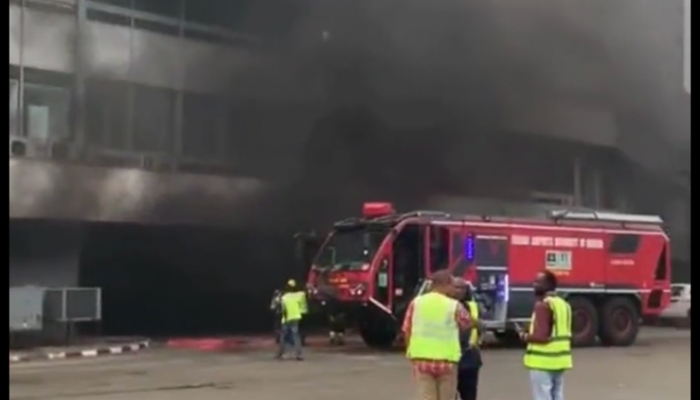
High-capacity fire tender deployed to combat a recent fire at the Murtala Muhammed International Airport, Ikeja, Lagos
The fears expressed by members of the Nigerian Aviation Fire and Safety Association (NAFSA) over an aspect of their members’ proposed training that would require teaching via zoom, has been allayed and assurance given that approved trips for training, and all the perquisites statutorily in consonance with the public service financial regulations shall be honoured.
Management of the Federal Airports Authority of Nigeria, FAAN, gave the reassurance that its personnel in the Aerodrome and Fire Fighting and Safety Department that the travel element of their trainings and the official perks it statutorily attracts shall be wholly honoured by the authority.
This obvious undercurrent in the initial condemnation of the Zoom aspect of the training program by the leadership of the Nigerian Aviation Fire and Safety Association (NAFSA) was clarified in a media statement issued by FAAN and signed by Henry Agbebire, Director, Public Affairs and Consumer Protection.
According to Agbebire, FAAN management had clarified that the proposed training wouldn’t be exclusively online but a hybrid, delivered in modules. And that a predominant fraction of the course module, he said, would be in-person while the few others would be virtual.
The media statement enunciated that training for the aerodrome fire fighter and safety personnel “is not an online-only training initiative, but a hybrid training model that integrates virtual learning, classroom instruction, and practical field exercises within a structured six-week training period”.
FAAN management acknowledged in its statement that “the hybrid or blended approach reflects modern global training practices and is designed to strengthen, not to weaken the competence of Airport Rescue and Firefighting (ARFF) personnel”.
It further clarified that, “While theoretical components of the course may be delivered through virtual platforms to improve learning efficiency and broaden participation, hands-on practical drills and live simulations remain a core part of the program”.
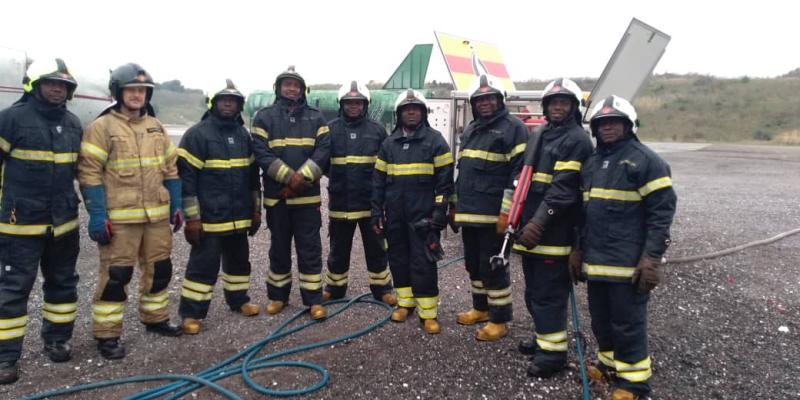
The statement reiterated that the “training framework by FAAN fully complies with the provisions of ICAO Annex 14, and NCAA Advisory Circular, which require practical sessions of drills, exercises and simulations”, it affirmed.
Highlighting the benefit, the statement noted, “The adoption of a hybrid learning model will allow FAAN to train a larger number of personnel efficiently, while maintaining operational coverage across airports, without compromising safety standards or operational readiness.” It concluded.
About Post Author