
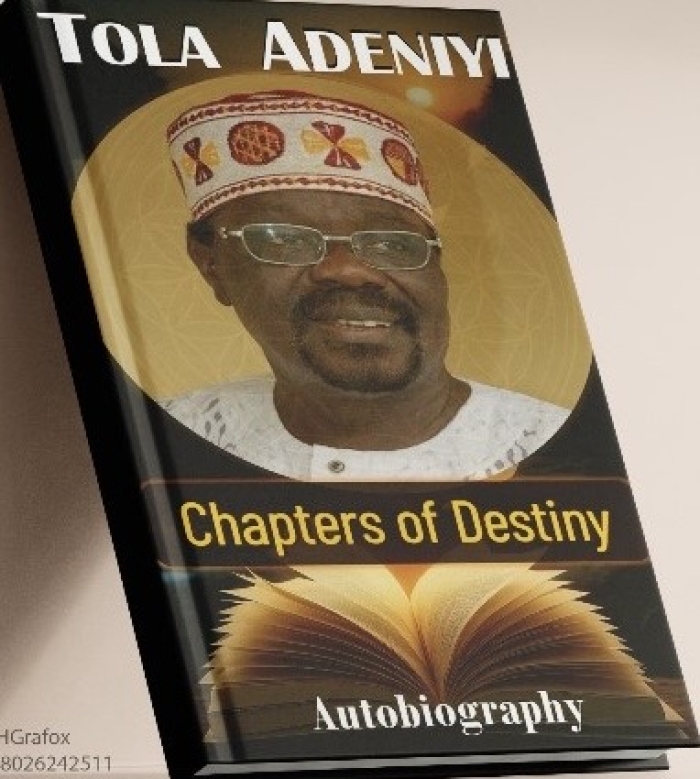
CHAPTERS of DESTINY: An Autobiography of Akogun Tola Adeniyi, a giant in media management, a prolific columnist, a prodigious author who has published over twenty-five books. Chief Tola Adeniyiis also known as Irunmole. He has also made several contributions to arts and culture in all its genres, no wonder the litany of chieftaincy titles bestowed on him.
Book review by Prof Anthony Kila:
Mr. chairman, Your Royal Highnesses, Distinguished guests, Elders and friends, Ladies and gentlemen, Please allow me to commence my intervention by thanking the author of “Chapters of Destiny”, Irumole Tola Adeniyi, for writing this book, not only because he has written a great book, but also because without this book, we would not be gathered here today.
We are gathered here today not merely to launch a book, but to begin a conversation that cannot be concluded in one sitting— much like the life we are here to honour.
Chapters of Destiny, the autobiography of Chief Tola Adeniyi, Some autobiographies tell us what a man did, and there are those rare books that explore how a country or an organisation became what it is and there are even rarer books that tell the story of a person’s life and explain why a country behaves the way it does.
Chapters of Destiny, the autobiography of Tola Adeniyi, belongs firmly to the very rare category. It is not merely the recollection of a long life well lived; it is a cartography of Nigerian public life drawn by someone who stood close enough to power to understand it, yet far enough away to resist it.
This book documents and unveils something many of us had an idea of but maybe lack details about: Yes, I refer to the life of Akogun Tola Adeniyi, who, as the book unambiguously shows us, has been a leading part of many things—journalism, theatre, public service, exile, faith, agitation—but never small, never conformist, never ordinary. And it is this refusal of smallness that animates the book.
Akogun Tola Adeniyi’s ‘Chapters of Destiny’ is not a memoir written for convenience or nostalgia. It is a work of reflection, interrogation, and record. It is the story of a life told not to impress, but to explain—explaining not only the making of a man but also the temperament of an age and the foibles of a nation.
Please allow me to, didactically, divide the book into parts: The first part of the book focuses on formation: the making of a mind, the discovery of voice, and the entry into public life.
The second part turns to confrontations, exile, philosophy, and legacy. From its opening pages, Chapters of Destiny signals that it will not be a conventional autobiography. It begins not with sentiment, but with metaphysics—with destiny, choice, and consequence. Chief Tola Adeniyi writes with striking clarity:
“The Self-Manifest gave every creature free will, and
thereafter placed the world on auto-drive: choose your path, and bear the consequences.”
That sentence is not ornamental. It is the philosophical backbone
of the entire book; it is the engine that drives the book. This is a
memoir that refuses to blame fate for failure or luck for success.
It insists—sometimes uncomfortably—that character matters,
and that decisions leave footprints.
The book begins with a journey into the Formation age of
Childhood and the Early Signs of Calling. In this part of the book,
Akogun Adeniyi reflects on childhood not as innocence but as
preparation. He does not romanticise beginnings; he analyses
them. Looking back, he observes with the rhythm of a poet and
the depth of a philosopher that:
“Fate began to show its powers in my life very early, long
before I knew its name or understood its temper.”
This is the voice of a man who understands hindsight without
illusion. Childhood, in this telling, is not refuge; it is rehearsal. It
is an important admission, because it signals what the book
repeatedly insists upon: destiny may set the stage, but character
writes the script.
These early chapters unfold like a meditation on the formation of
mind, of voice, of temperament. Akogun Tola Adeniyi’s childhood
is rendered not sentimentally, but analytically, as the first testing
ground of destiny
One of the most striking aspects of Chapters of Destiny is how naturally it moves between cultures without anxiety,
embarrassment, or fanfare. Without permission or explanations,
Qur’anic education sits comfortably beside Western schooling;
Yoruba metaphysics converses easily with Christian theology;
African orature shares space with Shakespeare.
In a country still trapped in false binaries—tradition versus
modernity, faith versus reason—Chief Tola Adeniyi offers a
formulation of enduring relevance. Irumole Adeniyi does not
experience these worlds as contradictions, and therein lies one
of the book’s quiet lessons for contemporary Nigeria. Please
listen to what he says with understated wisdom:
“I learned early that education is not a contest between
cultures, but a conversation between worlds.”
That sentence alone should be required reading for
policymakers, educators, and cultural custodians alike. It
captures, in one line, what decades of curriculum reform have
struggled to articulate and implement
The middle of the first part of the book takes us into an
exploration of the man inserted into his Language, Performance,
and the Discovery of Voice. It becomes unambiguously evident
that language is not merely a skill for Adeniyi—it is destiny
asserting itself. He describes his relationship with words in a
simple but revealing sentence. Language is not merely a tool but
a calling. Words arrive early and refuse to leave, listen to how he
puts it: “Words discovered me before I discovered words;
once they did, there was no retreat.”
This is not the language of career planning. It is the language of
consecration. And once that calling is accepted, the book shows
us, retreat becomes impossible—even when advance is
dangerous.
There are chapters on youth, theatre, debate, and performance,
these chapters are not digressions. They are rehearsals. Akogun
Adeniyi’s immersion in drama, poetry, and public speaking
becomes the training ground for later confrontations with power.
He learns early that audiences matter—but so does integrity. He
teaches us a lesson: Popularity is never allowed to replace truth.
It is a lesson dear to me and one my media students are familiar
with discussing: the concept of Journalism as Moral Vocation.
When the narrative reaches journalism, Chapters of Destiny
shifts decisively from formation to engagement. The newsroom
becomes Irumole Adeniyi’s arena—not for influence, but for
conscience. He reminds us, with the authority of lived
experience, that:
“The press is never dangerous to a just government; it is
lethal only to fear, incompetence, and deceit.” Dear Editors
and publishers, I believe that sentence deserves to be engraved
above your newsrooms across the country.
That is not just theory. It is a diagnosis. It explains why tyrants
and incompetent and corrupt governments fear scrutiny and why
accountability remains power’s most uncomfortable companion.
It is in the creation and flourishing of the Aba Saheed persona
that Adeniyi’s moral courage is most clearly on display. Aba
Saheed was not a mask meant to conceal; no fear, no shame,
rather it was a voice meant to sharpen perception. Through
satire and caustic commentary, Chief Adeniyi confronted both
military and civilian regimes with an audacity that now feels
almost unimaginable.
. At the moral centre of this period stands one of the book’s most
unsettling lines:
Yet, remarkably, in this book, Chief Adeniyi resists the
temptation to mythologise this period. The book avoids heroics.
It acknowledges and speaks openly about surveillance,
intimidation, physical danger, as well as fear, vulnerability, and
consequences. As an author, he is straightforward about these
dangers and even the cost of dissent, but he remains
unapologetic about the need to continue. “To be silent in the
presence of injustice is not neutrality; it is collaboration,” he
writes, a line that should trouble every comfortable bystander.
There are stories and lessons about Power, Proximity, and
Responsibility that must not be missed. As Chief Tola Adeniyi
moves closer to the corridors of power—government,
institutions, public service—the book acquires added value as a
historical document. He writes not as an outsider speculating,
but as an insider observing patterns. What emerges is a
consistent lesson: power resents scrutiny, but needs it.
Throughout the book, names appear in abundance—politicians,
journalists, intellectuals, traditional rulers. Yet the memoir never
degenerates into gossip or score-settling. Tola Adeniyi resists
the petty satisfactions of revelation. His concern is less with who
offended whom and more with how institutions behaved under
pressure, and, by doing so, the book establishes and maintains
its authority.
In this sense, Chapters of Destiny becomes something larger
than autobiography; it becomes a civic archive. As the author
observes with quiet urgency, “A nation that forgets its
storytellers will soon lose the story of itself.” He writes,
therefore, not merely to remember, but to preserve. As the
narrative deepens, the reader realises that this is no longer just
an autobiography. It has become a civic archive. Tola Adeniyi
understands that memory is a public responsibility. This book,
therefore, is not indulgence. It is preservation.
I pity those librarians and bookshop managers who will have to
catalogue and categorise this book. A biography, yes, but this
book can sit on many shelves. Many will be tempted to consider
it a political or social memoir, but what elevates Chapters of
Destiny beyond political memoir, however, is its refusal to reduce
human motivation to power alone.
The book, with remarkable ease, explores Faith, Philosophy, and
Moral Agency. Irumole Adeniyi is as interested in belief as he is
in politics. His exploration of Mareism and his understanding of
Olodumare are not presented as dogma but as philosophical
positions—attempts to reconcile freedom, fate, and
responsibility. One of the book’s most piercing observations
arrives almost casually: “God does not punish man; man
punishes himself by the choices he makes while blaming
heaven.” In a society prone to outsourcing accountability to
metaphysics, this is a bracing provocation.
In one sentence, he dismantles centuries of convenient theology
and returns responsibility to where it belongs: human agency.
As the book prepares us for displacement, Chief Tola Adeniyi
frames exile not as drama, but as recalibration. He introduces us
to the concept of Exile as Discipline, and he points out with
remarkable restraint that “Exile is not the absence of home; it
is the discipline of remembering who you are without
applause.” That sentence explains why this memoir avoids
bitterness. Exile becomes a moral classroom.
As the first part of the book draws to a close, we are left with a
portrait of a man fully formed: intellectually restless, morally
anchored, historically conscious. Akogun Toal Adeniyi offers no
plea for admiration. Instead, he offers clarity: “I did not live to
be liked by power; I lived to remain at peace with my
conscience.” Please allow me to point out that that line is not a
slogan. It is a standard.
Exile, in Chapters of Destiny, is neither melodrama nor
complaint. It is discipline. Adeniyi refuses the romanticism often
associated with displacement. Instead, he frames exile as a
stripping away of applause, proximity, and illusion. He writes with
unsentimental precision that: “Exile teaches you the
difference between recognition and relevance; one is noisy,
the other enduring.”
This chapter is especially instructive for leaders accustomed to
constant affirmation. Exile, in Chief Tola Adeniyi’s telling,
becomes a moral audit. Without familiar audiences, a man must
confront the sturdiness of his convictions.
This is where we see Work Without the Theatre of Power. In
Canada, Mr Tola Adeniyi continues to work—writing, teaching,
consulting, observing—but without the immediacy of Nigerian
political drama. This distance sharpens rather than dulls his
insight. He reflects: “Distance did not weaken my attachment
to Nigeria; it purified it of impatience.”
Here, exile becomes an intellectual advantage. Removed from
the urgency of daily outrage, Mr Tola Adeniyi sees patterns more
clearly. Nigeria, viewed from afar, becomes not a spectacle but
a question.
One of the most valuable contributions of Chapters of Destiny
lies in its insistence on institutional thinking. Adeniyi repeatedly
warns against the Nigerian habit of personalising failure. And
here I am, thrilled when public conversations, convictions and
decisions are about Institutions, Not Individuals.
Please listen to what Irumole says:“Nations do not fail
because of wicked individuals alone; they fail because weak
institutions learn to tolerate them.”
This sentence deserves to be read slowly. It shifts responsibility
from personalities to structures—from villains to systems. For
policymakers and executives alike, it is an uncomfortable but
necessary truth.
In these later chapters, we are served reflections on Philosophy
as Moral Accounting. Tola Adeniyi’s philosophical commitments
take centre stage. Mareism and his understanding of Olodumare
are no longer background beliefs; they become interpretive tools.
He returns again to the theme of choice and consequence,
insisting that: “Freedom without responsibility is not liberty;
it is abandonment.” This is philosophy with civic implications.
Chief Tola Adeniyi’s concern is not abstract metaphysics, but the
moral habits that make societies sustainable—or fragile.
Few sections of the book are as quietly devastating as we are
shown a Nigeria and the Tragedy of Repetition, in these parts,
Chief Adeniyi serves us his reflections on Nigeria’s political
cycles. He avoids despair, but he does not indulge optimism
either. Instead, he diagnoses repetition—the recycling of errors
disguised as change. He writes: “We mistake movement for
progress because standing still would require reflection.”
This sentence captures a national temperament. Activity
substitutes for introspection; noise replaces reform. The book
insists that without memory, nations cannot learn.
As the autobiography approaches its conclusion, ageing
emerges not as retreat but as recalibration. We are introduced
to the notion of Ageing Without Withdrawal. Baba Tola Adeniyi
refuses the cultural expectation that elders should either
withdraw politely or pontificate endlessly. Instead, He reflects
with humility that: “Age does not make one wiser by default;
it merely removes the excuse of ignorance.” This is a rebuke
disguised as wisdom—directed at leaders who mistake longevity
for insight.
The Epilogue of Chapters of Destiny is remarkable for its
restraint. It is a lesson in Legacy Without Self-Mythology. There
is no grand summation, no demand for recognition. Baba Tola
Adeniyi speaks instead of peace—earned, not negotiated, and
He writes: “I sought coherence, not applause; and I learned
that the two rarely arrive together.”
This line encapsulates the ethic that runs through the entire
book. Consistency, not popularity, is the measure of a life.
Elsewhere in the book, Adeniyi reflects on why he chose to write
at all, given the risks and fatigue involved and says: “I wrote
because silence would have been easier—and therefore
unforgivable.”
This is not bravado. It is moral arithmetic. The book insists that
difficulty does not absolve responsibility.
Near the close of the book, Baba Tola Adeniyi returns to where
he began—with destiny, choice, and consequence. But now the
reflection is seasoned by experience, and he tells us that:
“Destiny does not announce itself; it waits patiently for our
decisions to give it meaning.”
This is the book’s final philosophical gift. Destiny, in Tola
Adeniyi’s universe, is not fate imposed—it is possibility
negotiated.
Taken together, “Chapters of Destiny” is more than an
autobiography. It is a civic document, an intellectual archive, and
a moral ledger. It reminds us that history is not only made by
those who govern, but by those who observe, record, resist, and
remember.
For politicians, this book is a warning against the arrogance of
power.
For CEOs, it is a study in leadership under moral pressure.
For academics, it is a textured primary source on Nigeria’s
intellectual life.
For journalists, it is both a mirror and a standard.
Above all, it is a reminder that public life, when lived seriously,
leaves traces that matter.
Chief Tola Adeniyi has written not merely to recount his life, but
to preserve a standard—one that insists that conscience is not a
luxury, memory is not optional, and destiny, however mysterious,
still requires our consent.
With Chapters of Destiny, Chief Tola Adeniyi has given us not
only a book, but a burden: the burden of remembering, thinking,
and choosing better.
Chief Tola Adeniyi has written a book that refuses to flatter its
readers but invites them into a deeper conversation about
responsibility, courage, and meaning. In doing so, he has not
only told his story; he has enlarged ours.
It is my singular honour to commend Chapters of Destiny to you,
and to thank Chief Tola Adeniyi for writing not just his life, but a
chapter of our collective memory.
Thank you for your time and attention, and may God bless
everything and everyone dear to you.
About Post Author