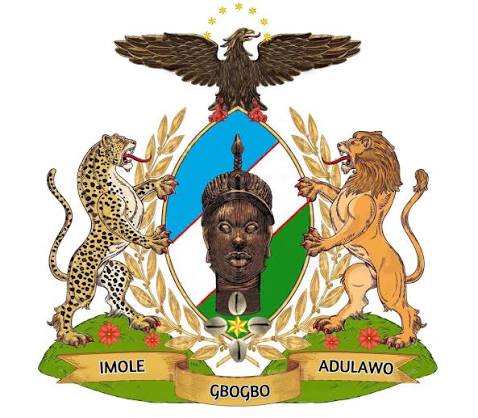
Oduduwa National Coat of Arms
There is something deeply troubling—and increasingly difficult to defend—about the continued refusal of Ekiti and Ondo States to officially recognise Isese Day. For societies that proudly proclaim their Yoruba identity, celebrate their ancestral heritage, and draw political and cultural legitimacy from the traditions of their forebears, the failure to recognise a day dedicated to Yoruba indigenous spirituality represents more than an administrative omission. It is a disturbing manifestation of cultural timidity, historical amnesia and institutional neglect.
Isese is not an imported ideology seeking accommodation in Yoruba society. It is part of the spiritual and cultural foundation upon which Yoruba civilisation was built. Long before the arrival of Christianity and Islam, Yoruba communities possessed sophisticated systems of morality, philosophy, medicine, governance, cosmology and spirituality. Isese provided—and continues to provide—a framework through which generations understood their relationship with Olodumare, the Òrìṣà, their ancestors, nature and the wider community.
To neglect Isese while simultaneously celebrating Yoruba culture selectively is therefore profoundly contradictory.
Ekiti and Ondo cannot claim to be guardians of Yoruba heritage when they are unwilling to give institutional recognition to one of its most fundamental dimensions. One cannot proudly celebrate Yoruba language, festivals, traditional rulers, drumming, dance, cuisine and historical monuments while treating Yoruba spirituality as something embarrassing that must remain hidden from public recognition.
That contradiction deserves to be challenged.
The argument that recognising Isese Day would somehow undermine Christianity or Islam is particularly weak. Nigeria is a constitutional democracy with a religiously plural population. Recognising an indigenous cultural and spiritual heritage does not require anyone to abandon their personal faith. Christians remain Christians. Muslims remain Muslims. Traditional worshippers remain traditional worshippers. A public holiday is, fundamentally, a statement of cultural recognition—not a command concerning what citizens must believe.
Indeed, the Southwest has already demonstrated that recognition is possible. Lagos, Ogun, Osun and Oyo have taken steps to recognise August 20 as Isese Day. Their decision should force Ekiti and Ondo to confront an uncomfortable question: Why should states with such profound Yoruba historical and cultural significance continue to lag in recognising Yoruba indigenous heritage?
The irony is especially painful because Ekiti and Ondo possess extraordinarily rich traditions of indigenous knowledge, festivals, oral history, sacred sites, traditional institutions and ancestral practices. Yet instead of presenting these traditions confidently as part of the intellectual and cultural wealth of the Yoruba people, the states appear reluctant to give them the official dignity they deserve.
This is not merely about a day off work.
It is about what a society chooses to remember.
It is about whose history receives official recognition and whose heritage is pushed into the shadows.
When a government declares a public holiday, it tells its citizens that the occasion matters. It tells younger generations that the history behind that occasion is worthy of remembrance. By refusing to recognise Isese Day, Ekiti and Ondo risk sending precisely the opposite message to their young people: that their indigenous spiritual heritage is somehow less respectable, less legitimate or less worthy of public celebration than traditions introduced from elsewhere.
That is a dangerous message in an age when indigenous cultures around the world are fighting to preserve languages, philosophies, sacred traditions and historical identities from extinction.
There is also a painful element of hypocrisy in the situation. Yoruba politicians routinely invoke ancestors, culture and tradition when appealing to the electorate. They celebrate traditional rulers, attend cultural festivals, speak proudly about Yoruba identity and invoke the history of their communities when it is politically convenient. Yet when traditionalists ask for formal recognition of Isese, the enthusiasm often disappears.
Culture cannot be something politicians celebrate only when it is convenient.
If Yoruba heritage is genuinely valuable, it must be defended in its entirety—including its indigenous spiritual foundations.
Ekiti and Ondo should therefore stop treating the recognition of Isese Day as a peripheral matter. Their governments should engage traditional worshippers, traditional rulers, cultural organisations, scholars and religious leaders in meaningful dialogue and establish a clear framework for recognising August 20.

Such recognition would not diminish Christianity or Islam. On the contrary, it would demonstrate confidence in the plural character of Yoruba society. A civilisation that is secure in its identity does not need to erase one part of its history to accommodate another.
The real danger is not that Isese will be recognised.
The real danger is that Yoruba people will gradually become strangers to the spiritual and intellectual traditions of their own ancestors.
Every generation has a responsibility to preserve what it inherited. Ekiti and Ondo therefore have a choice. They can continue the culture of hesitation, allowing indigenous spirituality to remain institutionally marginalised, or they can demonstrate the courage to acknowledge that Isese is an inseparable part of Yoruba civilisation.
For too long, indigenous spirituality has been expected to survive quietly while other traditions receive institutional visibility and public recognition. That era should end.
Ekiti and Ondo must recognise Isese Day—not as a favour to traditional worshippers, but as an affirmation of Yoruba history, cultural dignity and the right of an indigenous people to remember and honour their own heritage.
A people who abandon the spiritual foundations of their civilisation cannot indefinitely claim to be preserving the civilisation itself.
AUTHOR: Chief George Bamidele Ogunjimi Esq
Bamofin of Ojo Kingdom, Lagos.
About Post Author