

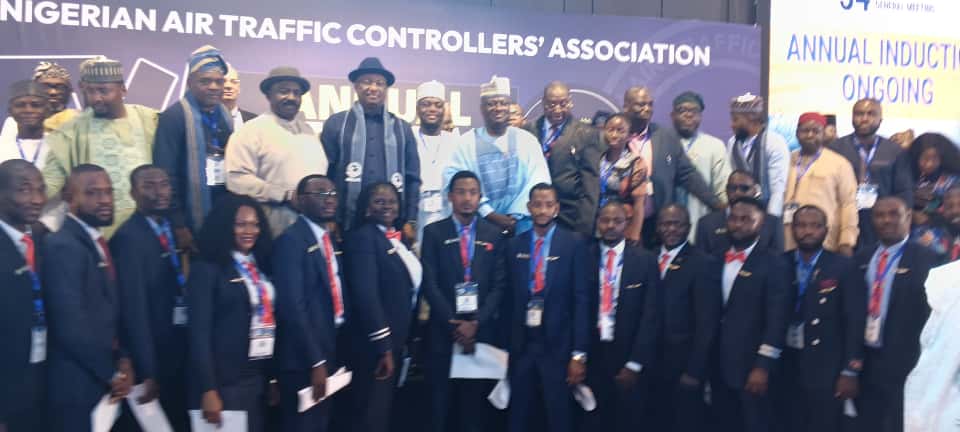
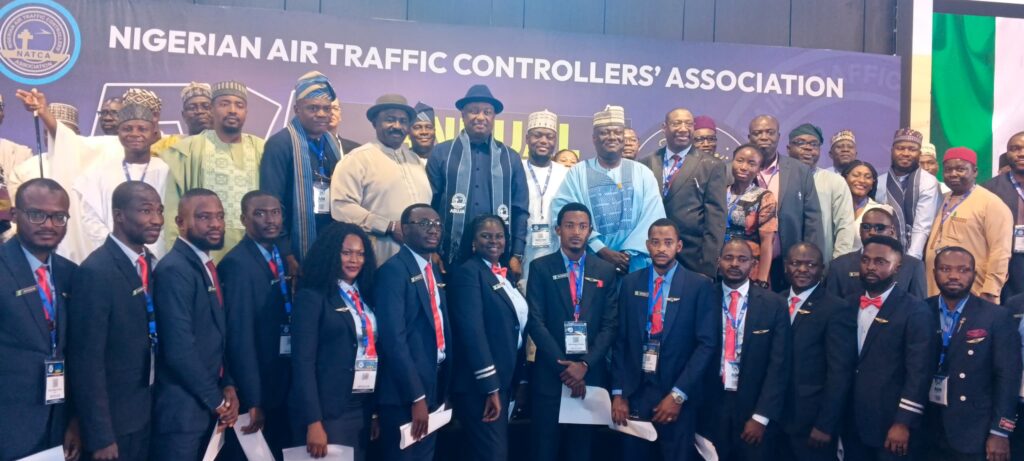
L-R: Dr Ahmed Umar Farouk, MD, NAMA, (5th); Capt Chris Najomo, DGCA, NCAA, (6th); Barr Festus Keyamo, Aviation & Aerospace Development Minister, (7th); Dr Abubakar Kana, Permanent Secretary, Ministry of Aviation & Aerospace Development, (8th); Comrade Edino Ilemona Amos, President, NATCA, (9th)
Barr Festus Keyamo, Aviation and Aerospace Development Minister, has pledged to invoke his expertise in the advocacy for human and workers’ rights to ultimately ensure equity, fairness, and socio-economic justice in the retirement age of Air Traffic Controllers, ATC.
The Minister who believed that, whatever is sauce for the goose should also be sauce for the gander hence, assured of his office subliminal engagement of concerned government agencies, through the instrumentality of the law and by exploiting the public service regulations and the legalese within the confines of civil service administration to tinker with the retirement age of Air Traffic Controller, ATC, and raise it to be at par with what obtained among the Pilots in the world of air transportation.
Barr Festus Keyamo dropped the hint at the 54th Annual General Meeting, AGM, of the Nigerian Air Traffic Controllers Association, NATCA, held at the Nigerian Air Force, NAF, conference centre, Abuja, on Tuesday, 21st October 2025.
The minister believed that as a quick fix to the clear and imminent da ger posed by an inadequate number of ATCs to run approved shifts as recommended by the International Civil Aviation Organisation, ICAO, and in mitigating the dire consequences therefrom, he would, without delay, begin to push for retirement age of 65 years for ATC, in the same manner with the Pilots.
He also highlighted that another benefit of that proposition is that more experienced ATCs will be available to share their wealth of experience with the younger ones.
Keyamo enthused, “I listened to his speech on the age of retirement of Air Traffic Controllers, I think I am convinced it is something I can take up”, he said.
He noted that if pilots can fly at the age of 65, there is no reason for Air Traffic Controllers not to consider 65 as the retirement age.
Describing NATCA as the ‘Apple of the eye of Aviation’, the minister reassured ATCOs of the necessary support needed to make them function effectively, as they are in charge of the safety of the skies.
The Managing Director, Nigerian Airspace Management Agency, NAMA, Engr Ahmed Umar Farouk, said the critical issue of staff welfare merely needed implementation. As the Condition of Service, CoS, had been signed since August 2025.
Engr Farouk announced that, “the NAMA Management is on the verge of implementing the new Conditions of Service (COS) as soon as the National Salaries and Wages Commission, NSWC, releases it. We are actively following up on this.”
He said “Its implementation will significantly improve the take-home package of all NAMA staff, including our dedicated Air Traffic Controllers, with all the consequential benefits for productivity and quality of living”.
He said further, “Our efforts directly mirror the challenges and imperatives highlighted in NATCA’s conference brochure as NAMA is not just preparing for the next generation; we are building it, equipping you with the skills, knowledge, and confidence to excel”.
The “Human Edge” is about fostering adaptability, analytical thinking, and resilience. Our unprecedented investment in training, both internationally and locally, coupled with our massive domestic infrastructure rollout, is designed to do exactly that.
He appealed for a rethink of the decision by the government to deductions-at source of between 30% and 50% made directly from NAMA’s internally generated revenue. While we understand the fiscal pressures on the government, these deductions severely limit our capacity to undertake the comprehensive projects our airspace demands.

President of NATCA, Comrade Edino Ilemona Amos, said “by 2026, NATCA will work towards establishing a dedicated Aeromedical and Fatigue Management Support Desk to address occupational health challenges”.
Edino added, “We also plan to expand psychological and stress support services to reach every control unit nationwide, recognising the unique cognitive strain of our profession”.
He emphasised that, “NATCA’s greatest asset remains its people. With over 700 active controllers and trainees across the nation, our strength lies in solidarity. We will continue to foster unity across all stations, chapters, and directorates, ensuring that our collective voice remains strong, respected, and effective”.
About Post Author